
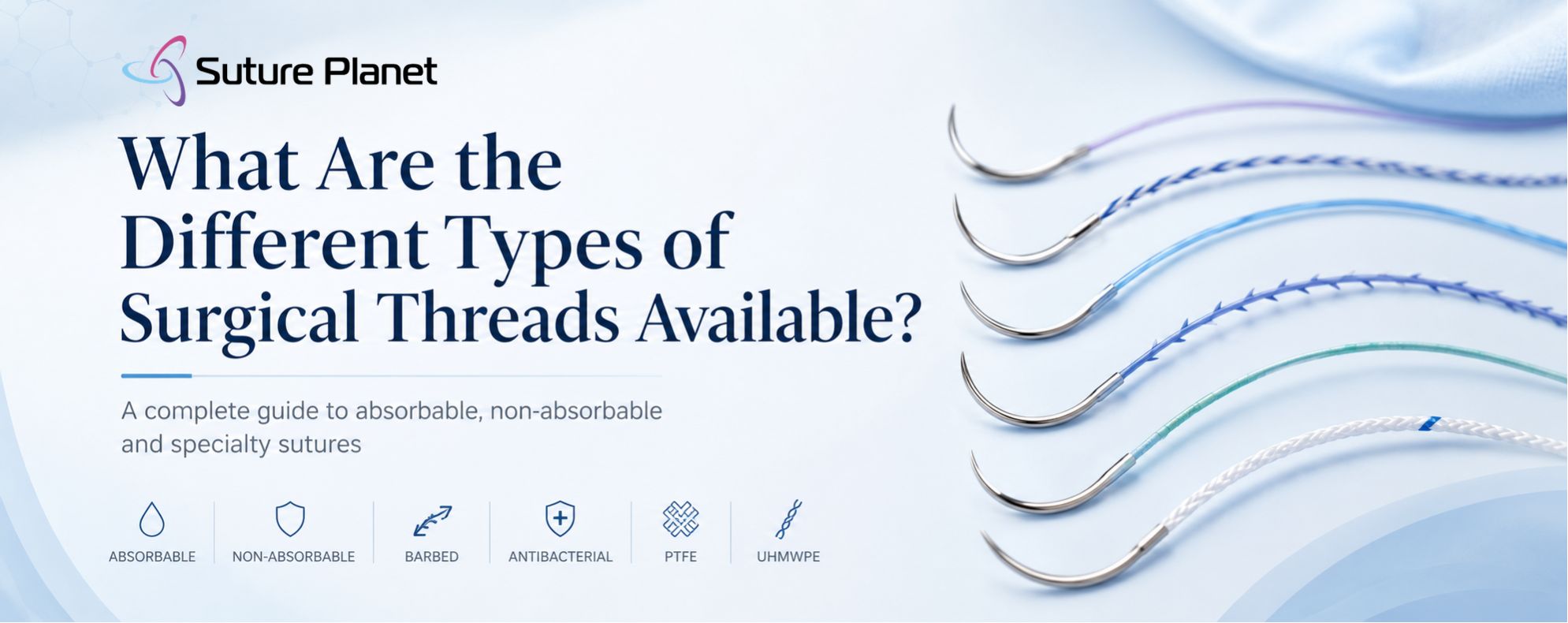

Surgical threads, also known as surgical sutures, are sterile medical devices used to close wounds, approximate tissues and support healing after surgery.
Different surgical procedures require different suture materials. The right surgical thread depends on tissue type, wound tension, healing time, infection risk and the duration of support required.
Surgical threads are mainly classified as absorbable and non-absorbable sutures. They can also be categorized as monofilament, braided, natural, synthetic, barbed or antibacterial.
Suture Planet offers a comprehensive range of conventional and speciality surgical sutures for different medical and surgical applications.
1. Absorbable Surgical Threads
Absorbable sutures gradually lose their tensile strength and are absorbed by the body after supporting the tissue during healing.
They are commonly used for internal tissue approximation where suture removal is not required.
Polyglactin 910 Suture – Netcryl®
Netcryl® is a synthetic, braided and coated absorbable suture.
It offers reliable knot security, smooth handling and predictable absorption.
Common applications include:
- General surgery
- Gynaecology
- Gastrointestinal surgery
- Soft-tissue approximation
- Subcuticular closure
Polyglactin Rapid Suture – Netcryl® Fast
Netcryl® Fast is a rapidly absorbing braided suture developed for tissues that heal quickly.
It may be used for:
- Superficial skin closure
- Oral surgery
- Mucosal closure
- Episiotomy closure
- Paediatric procedures
Polyglycolic Acid Suture – Netsorb®
Netsorb® is a synthetic braided absorbable suture manufactured from polyglycolic acid, commonly known as PGA.
It provides good tensile strength, handling and knot performance.
It may be considered for general surgery, orthopaedic procedures, gastrointestinal surgery and tissue ligation.
Poliglecaprone 25 Suture – Netcryl® Mono
Netcryl® Mono is a synthetic monofilament absorbable suture.
Its smooth surface supports easy tissue passage with reduced tissue drag.
Common applications include:
- Subcuticular closure
- General surgery
- Urology
- Paediatric surgery
- Soft-tissue approximation
Polydioxanone Suture – Netsynth®
Netsynth® is a long-term absorbable monofilament suture manufactured from polydioxanone.
It provides prolonged wound support and may be suitable for slower-healing tissues.
Applications may include fascial closure, orthopaedic surgery, general surgery and paediatric cardiovascular procedures.
Catgut Suture – Netgut®
Netgut® is a natural absorbable suture made from purified collagen.
It is available in:
- Plain Catgut
- Chromic Catgut
Plain catgut is absorbed more rapidly, while chromic catgut provides extended tissue support.
2. Non-Absorbable Surgical Threads
Non-absorbable sutures are designed to provide long-term tissue support.
They may remain permanently within the body or be removed after the wound has healed.
Polypropylene Suture – Netlene®
Netlene® is a synthetic monofilament non-absorbable suture.
It offers high tensile strength, smooth tissue passage and minimal tissue reaction.
It is commonly considered for:
- Cardiovascular surgery
- Vascular procedures
- Hernia repair
- Plastic surgery
- General soft-tissue approximation
Nylon Suture – Netplast®
Netplast® is a synthetic monofilament nylon suture.
It is frequently used for skin closure because of its smooth surface and ease of removal.
It may also be considered for plastic surgery, ophthalmic procedures and microsurgery.
Silk Suture – Netsilk®
Netsilk® is a natural braided non-absorbable suture known for soft handling and reliable knot security.
It may be used for tissue ligation, general surgery, gastrointestinal procedures and selected ophthalmic applications.
Polyester Suture – Netbond®
Netbond® is a synthetic braided non-absorbable suture.
It provides high tensile strength and long-term support.
Common applications include cardiovascular surgery, orthopaedics, tendon repair, ligament repair and general surgery.
3. Barbed Surgical Sutures
Barbed sutures contain small projections that engage the tissue and distribute tension along the wound.
They can support knotless tissue approximation in selected procedures.
VFIX® Polydioxanone Barbed Suture
VFIX® is an absorbable monofilament barbed suture made from polydioxanone.
It is available in unidirectional and bidirectional configurations.
Potential applications include:
- Laparoscopic procedures
- Gynaecological surgery
- Urology
- Cosmetic surgery
- Gastrointestinal surgery
- Vaginal cuff closure
4. Antibacterial Surgical Sutures
Antibacterial sutures are coated with an antimicrobial agent intended to help inhibit bacterial colonization on the suture surface.
Suture Planet’s antibacterial suture range includes:
- V-FIX® AB Polydioxanone Barbed Suture
- Netcryl® AB Polyglactin 910 Suture
- Netsynth® AB Polydioxanone Suture
- Netcryl® Mono AB Poliglecaprone 25 Suture
These sutures combine tissue support with antibacterial surface protection.
5. UHMWPE Surgical Sutures
UHMWPE stands for Ultra-High Molecular Weight Polyethylene.
UHMWPE sutures are high-strength, braided and non-absorbable.
Ultranet® Fiber
Ultranet® Fiber is designed for high-tension procedures.
Potential applications include:
- Tendon repair
- Ligament repair
- Sports injury procedures
- Orthopaedic surgery
- Sternum closure
6. PTFE Surgical Sutures
PTFE stands for Polytetrafluoroethylene.
PTFE sutures are soft, flexible, monofilament and non-absorbable.
NETPTFE®
NETPTFE® is manufactured from medical-grade PTFE.
Its smooth structure supports handling in delicate procedures.
It may be considered for:
- Cardiovascular surgery
- Vascular procedures
- Dental surgery
- Periodontal surgery
- Soft-tissue approximation
Monofilament vs Braided Sutures
Monofilament Sutures
Monofilament sutures are made from a single strand.
Examples include polypropylene, nylon, polydioxanone, Poliglecaprone 25 and PTFE.
They offer smooth tissue passage, lower tissue drag and reduced capillarity.
Braided Sutures
Braided sutures are manufactured from multiple fibers woven together.
Examples include Polyglactin 910, PGA, silk, polyester and UHMWPE.
They generally provide good flexibility, handling and knot security.
How to Select the Right Surgical Thread
The appropriate surgical suture should be selected according to:
- Tissue-healing time
- Required tensile strength
- Absorption period
- Infection risk
- Tissue reactivity
- Knot security
- Surgical specialty
- Surgeon preference
The final decision must always be made by a qualified healthcare professional according to the procedure and approved product instructions.
Complete Suture Planet Range
Suture Planet offers:
- Absorbable sutures
- Non-absorbable sutures
- Barbed sutures
- Antibacterial sutures
- PTFE sutures
- UHMWPE sutures
- Monofilament and braided options
- Multiple needle and thread combinations
- OEM and private-label solutions
Conclusion
Different types of surgical threads are designed to meet different tissue-healing and procedural requirements.
Absorbable sutures provide temporary support, while non-absorbable sutures offer long-term approximation. Speciality options such as barbed, antibacterial, PTFE and UHMWPE sutures support advanced surgical needs.
Suture Planet provides a comprehensive range of surgical sutures for hospitals, distributors, healthcare companies and international medical-device markets.
Contact Suture Planet to explore surgical suture specifications, needle combinations, OEM manufacturing and private-label opportunities.
Medical Disclaimer: This content is for general educational and product-information purposes only. Suture selection must be performed by qualified healthcare professionals according to the procedure, patient condition and approved instructions for use.

